Patyka · skincare
Élixir Nuit Régénérant
Regenerating night serum built on 16 organic botanical essential oils, for mature or devitalised skin.
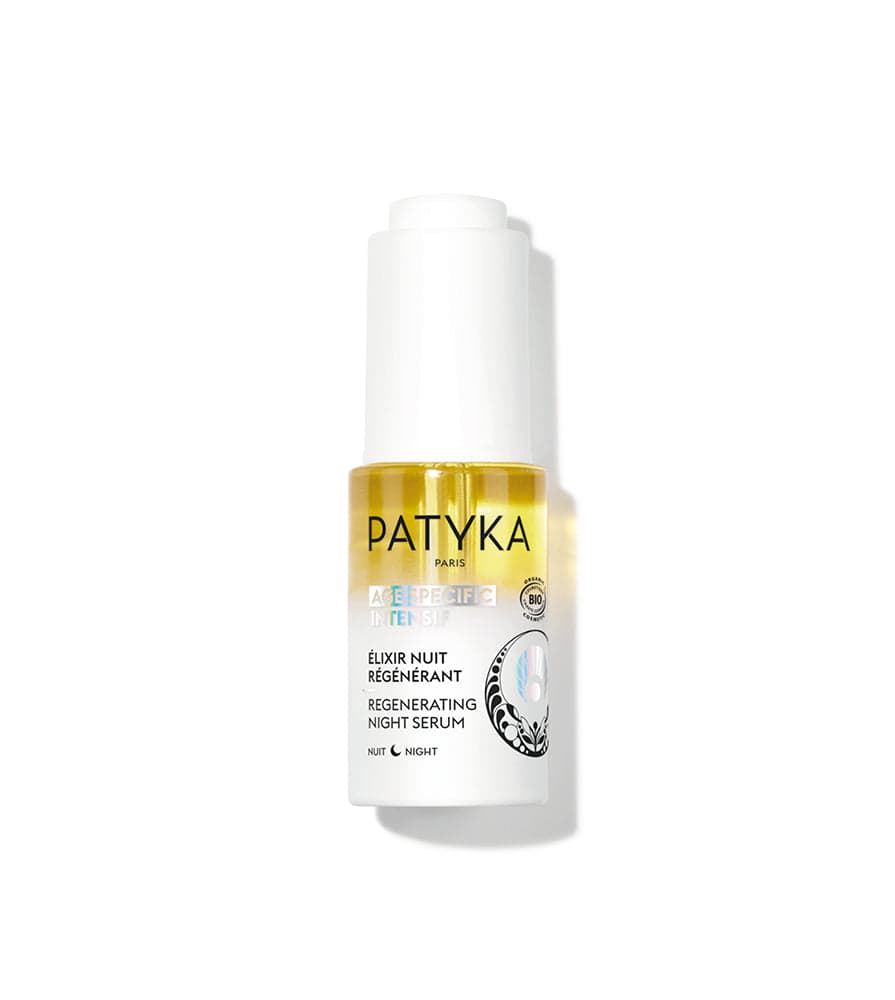
Photo: Patyka — product image from the brand's own listing.
Our take
Patyka was among the first brands Ecocert certified, back in 2002, and the serum is genuinely concentrated — but it sits at a founder-brand price, not a mass one.
Evidence score
4/4
Well evidencedHow much of this product's ethics we can actually prove — not how ethical it is. Each point is a yes-or-no check you can verify.
- This product is certifiedIt holds at least one certification issued by an independent body — not by its maker.
- Covers more than one dimensionIts certifications span at least two of nature, people and animals — not strong on one axis while silent on the rest.
- Composition publishedWe hold the full ingredient or materials list, per component where it matters, read from the maker's own listing.
- Composition mostly checkedAt least half of what it's made of has been matched against our sourced reference table.
Evidence at a glance
Three dimensions, weighted equally
2 of 3 independently certified
Certified means a third-party label backs it, with a source you can check. Stated means someone says so without one. Not found means we found nothing — not that the product fails.
What's inside
30 ingredients listed · 70% checked against our reference
The list as printed on the pack, in order — INCI runs from most to least concentrated, down to 1%. Flags cite EU law, not our opinion.
- ROSA CANINA FRUIT OILorganicNot assessed
- SESAMUM INDICUM (SESAME) SEED OILorganicNot assessed
LIMONENEnaturally presentFragrance component
Declarable fragrance allergen: must be named on the label above 0.001% in leave-on or 0.01% in rinse-off products. Commonly occurs naturally in essential oils. Occurs in citrus peel oils; can oxidise on contact with air, which is what raises its sensitising potential.
Limonene at source ↗- CITRUS NOBILIS (MANDARIN ORANGE) PEEL OILorganicNot assessed
CITRUS AURANTIUM BERGAMIA PEEL OILnaturally presentFragrance component
Declarable fragrance allergen: must be named on the label above 0.001% in leave-on or 0.01% in rinse-off products. Commonly occurs naturally in essential oils. Annex III entry 352. The whole essential oil is declarable.
Bergamot peel oil at source ↗PELARGONIUM GRAVEOLENS FLOWER OILnaturally presentFragrance component
Declarable fragrance allergen: must be named on the label above 0.001% in leave-on or 0.01% in rinse-off products. Commonly occurs naturally in essential oils. Annex III entry 364. The whole essential oil is declarable.
Geranium oil at source ↗- TRITICUM VULGARE (WHEAT) GERM OILorganicNot assessed
CITRUS LIMON (LEMON) PEEL OILnaturally presentFragrance component
Declarable fragrance allergen: must be named on the label above 0.001% in leave-on or 0.01% in rinse-off products. Commonly occurs naturally in essential oils. Annex III entry 353. The whole essential oil is declarable, over and above the limonene and citral it contains.
Lemon peel oil at source ↗LINALYL ACETATEnaturally presentFragrance component
Declarable fragrance allergen: must be named on the label above 0.001% in leave-on or 0.01% in rinse-off products. Commonly occurs naturally in essential oils. Annex III entry 337. Found in lavender, bergamot and clary sage oils.
Linalyl acetate at source ↗PINENEnaturally presentFragrance component
Declarable fragrance allergen: must be named on the label above 0.001% in leave-on or 0.01% in rinse-off products. Commonly occurs naturally in essential oils. Annex III entry 371 (alpha- and beta-pinene together). Found in pine and conifer oils; as a monoterpene it is also subject to the peroxide-value limit of entry 130.
Pinene at source ↗LINALOOLnaturally presentFragrance component
Declarable fragrance allergen: must be named on the label above 0.001% in leave-on or 0.01% in rinse-off products. Commonly occurs naturally in essential oils. Found in lavender, rosewood and coriander oils.
Linalool at source ↗- CITRUS AURANTIFOLIA (LIME) OILorganicNot assessed
- SALVIA SCLAREA (CLARY) OILorganicNot assessed
LAVANDULA OIL/EXTRACTnaturally presentFragrance component
Declarable fragrance allergen: must be named on the label above 0.001% in leave-on or 0.01% in rinse-off products. Commonly occurs naturally in essential oils. Annex III entry 360: Lavandula angustifolia, hybrida and intermedia oils and extracts are declared under this collective name.
Lavender oil / extract at source ↗MENTHA VIRIDIS (SPEARMINT) LEAF OILnaturally presentFragrance component
Declarable fragrance allergen: must be named on the label above 0.001% in leave-on or 0.01% in rinse-off products. Commonly occurs naturally in essential oils. Annex III entry 362. The whole essential oil is declarable.
Spearmint oil at source ↗CITRONELLOLnaturally presentFragrance component
Declarable fragrance allergen: must be named on the label above 0.001% in leave-on or 0.01% in rinse-off products. Commonly occurs naturally in essential oils. Found in rose and geranium oils.
Citronellol at source ↗- MENTHA ARVENSIS PIPERASCENS HERB OILorganicNot assessed
GERANIOLnaturally presentFragrance component
Declarable fragrance allergen: must be named on the label above 0.001% in leave-on or 0.01% in rinse-off products. Commonly occurs naturally in essential oils. Found in rose, palmarosa and citronella oils.
Geraniol at source ↗TERPINOLENEnaturally presentFragrance component
Declarable fragrance allergen: must be named on the label above 0.001% in leave-on or 0.01% in rinse-off products. Commonly occurs naturally in essential oils. Annex III entry 133. Found in tea tree and citrus oils; the peroxide value must stay below 10 mmol/L.
Terpinolene at source ↗MENTHOLnaturally presentFragrance component
Declarable fragrance allergen: must be named on the label above 0.001% in leave-on or 0.01% in rinse-off products. Commonly occurs naturally in essential oils. Annex III entry 338 (all isomers). Found in mint oils; also used for its cooling effect.
Menthol at source ↗CARVONEnaturally presentFragrance component
Declarable fragrance allergen: must be named on the label above 0.001% in leave-on or 0.01% in rinse-off products. Commonly occurs naturally in essential oils. Annex III entry 333 (both enantiomers). Found in spearmint and caraway oils.
Carvone at source ↗TERPINEOLnaturally presentFragrance component
Declarable fragrance allergen: must be named on the label above 0.001% in leave-on or 0.01% in rinse-off products. Commonly occurs naturally in essential oils. Annex III entry 343 (alpha-, beta- and gamma-terpineol together). Found in pine, lavender and cajeput oils.
Terpineol at source ↗BETA-CARYOPHYLLENEnaturally presentFragrance component
Declarable fragrance allergen: must be named on the label above 0.001% in leave-on or 0.01% in rinse-off products. Commonly occurs naturally in essential oils. Annex III entry 332. Found in clove, black pepper and cannabis oils.
Beta-caryophyllene at source ↗CITRALnaturally presentFragrance component
Declarable fragrance allergen: must be named on the label above 0.001% in leave-on or 0.01% in rinse-off products. Commonly occurs naturally in essential oils. Found in lemongrass, lemon and verbena oils.
Citral at source ↗ALPHA-TERPINENEnaturally presentFragrance component
Declarable fragrance allergen: must be named on the label above 0.001% in leave-on or 0.01% in rinse-off products. Commonly occurs naturally in essential oils. Annex III entry 131. Found in tea tree and cardamom oils; the peroxide value must stay below 10 mmol/L.
Alpha-terpinene at source ↗- CISTUS LADANIFERUS OILorganicNot assessed
- SANTALUM AUSTROCALEDONICUM WOOD OILorganicNot assessed
SANTALOLnaturally presentFragrance component
Declarable fragrance allergen: must be named on the label above 0.001% in leave-on or 0.01% in rinse-off products. Commonly occurs naturally in essential oils. Annex III entry 341 (alpha- and beta-santalol together). The main constituent of sandalwood oils.
Santalol at source ↗GERANYL ACETATEnaturally presentFragrance component
Declarable fragrance allergen: must be named on the label above 0.001% in leave-on or 0.01% in rinse-off products. Commonly occurs naturally in essential oils. Annex III entry 369. Found in geranium, citronella and lemongrass oils.
Geranyl acetate at source ↗CITRUS AURANTIUM FLOWER OILnaturally presentFragrance component
Declarable fragrance allergen: must be named on the label above 0.001% in leave-on or 0.01% in rinse-off products. Commonly occurs naturally in essential oils. Annex III entry 350: Citrus Aurantium Amara and Dulcis flower oils are declared under this collective name.
Neroli (bitter and sweet orange flower oil) at source ↗
Open any assessed entry to read what it does and why, with the source it came from. “Not assessed” means it isn't in our reference table yet — not that it's been cleared. We only mark what we can source. This list was read from Patyka ↗, not reconstructed.
Why it qualifies
The verifiable part — every certification this product holds, and what each one actually guarantees.
Cosmébio
Association CosmébioFrench organic-cosmetics charter: minimum organic content, no petrochemicals, transparent sourcing.
About Patyka
Parisian organic skincare — among the first brands Ecocert certified, back in 2002.
Company-level certification
Held by the company, not by this product. The same maker can ship a certified line and an uncertified one, so this is context — it does not count towards the score above.
Outbound links may be affiliate links. We never hold stock or process payments. Price bands are indicative and not tracked live — check the merchant for the current figure.