Florame · skincare
Sérum Global Anti-Imperfections
Face serum for combination to oily, blemish-prone skin, with organic tea tree and witch hazel floral waters and mastic resin.
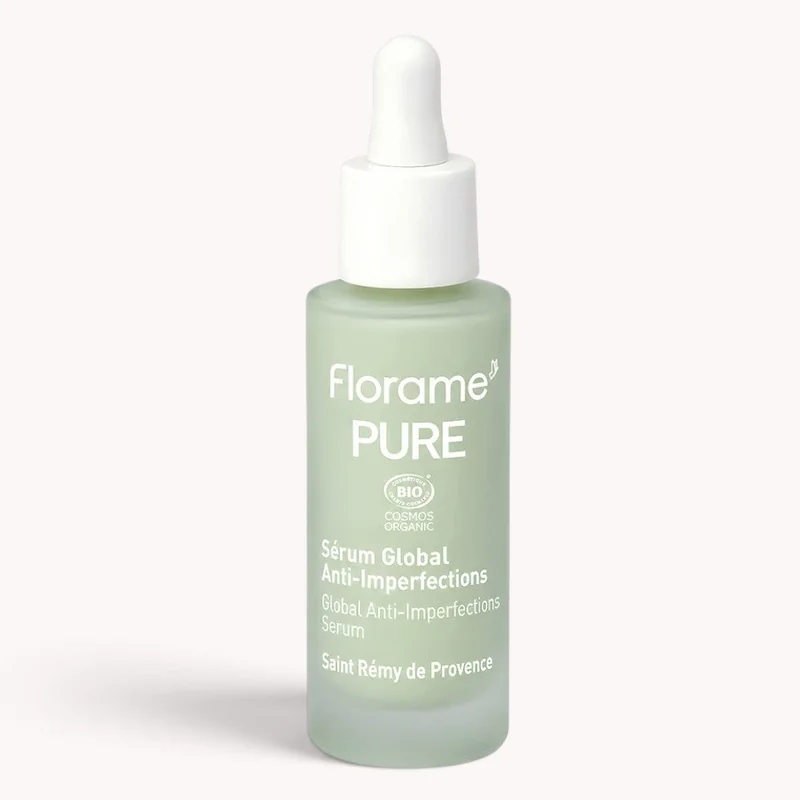
Photo: Florame — product image from the brand's own listing.
Our take
A COSMOS Organic serum for blemish-prone skin, built on organic tea-tree and witch-hazel waters. The page advises against using it during pregnancy or breastfeeding.
Evidence score
2/4
Partly evidencedHow much of this product's ethics we can actually prove — not how ethical it is. Each point is a yes-or-no check you can verify.
- This product is certifiedIt holds at least one certification issued by an independent body — not by its maker.
- Covers more than one dimensionNot metIts certifications span at least two of nature, people and animals — not strong on one axis while silent on the rest.
- Composition publishedWe hold the full ingredient or materials list, per component where it matters, read from the maker's own listing.
- Composition mostly checkedNot metAt least half of what it's made of has been matched against our sourced reference table.
Evidence at a glance
Three dimensions, weighted equally
1 of 3 independently certified
Certified means a third-party label backs it, with a source you can check. Stated means someone says so without one. Not found means we found nothing — not that the product fails.
- NatureCertifiedCOSMOS Organic
- PeopleNot foundNothing on record
- AnimalsNot foundNothing on record
What's inside
48 ingredients listed · 46% checked against our reference
The list as printed on the pack, in order — INCI runs from most to least concentrated, down to 1%. Flags cite EU law, not our opinion.
Aqua (Water)Solvent
Water. Usually the largest single component of a cream or lotion, which is why it heads most INCI lists.
Water at source ↗GlycerinHumectant
Draws water into the skin's surface layers. May be plant- or animal-derived; certified organic and vegan products use the plant route.
Glycerin at source ↗- Dicaprylyl EtherNot assessed
- Hamamelis Virginiana (Witch Hazel) Leaf WaterorganicNot assessed
- Lactobacillus/Punica Granatum Fruit Ferment ExtractNot assessed
- Melaleuca Alternifolia Leaf WaterorganicNot assessed
- OctyldodecanolNot assessed
- Caprylic/Capric TriglycerideNot assessed
- Glyceryl Stearate CitrateNot assessed
- Microcrystalline CelluloseNot assessed
- Nigella Sativa Seed OilorganicNot assessed
- PropanediolNot assessed
Aloe Barbadensis Leaf Juice PowderorganicSkin conditioning
Juice pressed from aloe leaves. Frequently listed high for marketing effect while present at low concentration — its position in the list matters more than its presence.
Aloe vera leaf juice at source ↗- Camellia Sinensis Leaf ExtractorganicNot assessed
- Cymbopogon Martini OilorganicNot assessed
- Mentha Piperita (Peppermint) OilorganicNot assessed
- Citrus Aurantium Amara (Bitter Orange) Leaf/Twig OilorganicNot assessed
- Centella Asiatica Leaf ExtractNot assessed
- Rhodomyrtus Tomentosa Fruit ExtractNot assessed
Helianthus Annuus (Sunflower) Seed OilEmollient
A light, widely available plant oil that is often grown in Europe, making it a lower-transport alternative to tropical oils.
Sunflower seed oil at source ↗Mentha Viridis (Spearmint) Leaf OilFragrance component
Declarable fragrance allergen: must be named on the label above 0.001% in leave-on or 0.01% in rinse-off products. Commonly occurs naturally in essential oils. Annex III entry 362. The whole essential oil is declarable.
Spearmint oil at source ↗- Lauryl GlucosideNot assessed
- Polyglyceryl-2 DipolyhydroxystearateNot assessed
Xanthan GumThickener and stabiliser
Polysaccharide produced by bacterial fermentation of sugars. Thickens water-based formulas and keeps them from separating; accepted under the COSMOS organic standard.
Xanthan gum at source ↗Parfum (Fragrance)Perfuming
An umbrella term: the individual components need not be listed, except for the 80 allergens that must be named separately. A short INCI list with PARFUM on it is less transparent than it appears.
Fragrance at source ↗Sodium BenzoatePreservative
Permitted preservative under Annex V within stated concentration limits. Accepted in organic-certified formulations.
Sodium benzoate at source ↗- Leuconostoc/Radish Root Ferment FiltrateNot assessed
Citric AcidpH adjuster
Adjusts a formula towards the skin's slightly acidic pH. Present in small amounts near the end of most INCI lists.
Citric acid at source ↗Potassium SorbatePreservative
Permitted preservative under Annex V within stated concentration limits. Accepted in organic-certified formulations.
Potassium sorbate at source ↗- CI 77288Not assessed
- Cellulose GumNot assessed
- Hydrolyzed AlginNot assessed
Citrus Limon (Lemon) Peel OilFragrance component
Declarable fragrance allergen: must be named on the label above 0.001% in leave-on or 0.01% in rinse-off products. Commonly occurs naturally in essential oils. Annex III entry 353. The whole essential oil is declarable, over and above the limonene and citral it contains.
Lemon peel oil at source ↗- Pistacia Lentiscus (Mastic) GumNot assessed
LimoneneFragrance component
Declarable fragrance allergen: must be named on the label above 0.001% in leave-on or 0.01% in rinse-off products. Commonly occurs naturally in essential oils. Occurs in citrus peel oils; can oxidise on contact with air, which is what raises its sensitising potential.
Limonene at source ↗Sodium HydroxidepH adjuster
Caustic soda, listed in Annex III with concentration limits. Used to neutralise a formula to skin-compatible pH; it is consumed in that reaction rather than remaining as such.
Sodium hydroxide at source ↗TocopherolAntioxidant
Protects oils in the formula from going rancid. Commonly added to plant-oil-heavy products for shelf life.
Vitamin E at source ↗LinaloolFragrance component
Declarable fragrance allergen: must be named on the label above 0.001% in leave-on or 0.01% in rinse-off products. Commonly occurs naturally in essential oils. Found in lavender, rosewood and coriander oils.
Linalool at source ↗MentholFragrance component
Declarable fragrance allergen: must be named on the label above 0.001% in leave-on or 0.01% in rinse-off products. Commonly occurs naturally in essential oils. Annex III entry 338 (all isomers). Found in mint oils; also used for its cooling effect.
Menthol at source ↗GeraniolFragrance component
Declarable fragrance allergen: must be named on the label above 0.001% in leave-on or 0.01% in rinse-off products. Commonly occurs naturally in essential oils. Found in rose, palmarosa and citronella oils.
Geraniol at source ↗PineneFragrance component
Declarable fragrance allergen: must be named on the label above 0.001% in leave-on or 0.01% in rinse-off products. Commonly occurs naturally in essential oils. Annex III entry 371 (alpha- and beta-pinene together). Found in pine and conifer oils; as a monoterpene it is also subject to the peroxide-value limit of entry 130.
Pinene at source ↗- Beta-SitosterolNot assessed
- Zinc SulfateNot assessed
Geranyl AcetateFragrance component
Declarable fragrance allergen: must be named on the label above 0.001% in leave-on or 0.01% in rinse-off products. Commonly occurs naturally in essential oils. Annex III entry 369. Found in geranium, citronella and lemongrass oils.
Geranyl acetate at source ↗- SqualeneNot assessed
CarvoneFragrance component
Declarable fragrance allergen: must be named on the label above 0.001% in leave-on or 0.01% in rinse-off products. Commonly occurs naturally in essential oils. Annex III entry 333 (both enantiomers). Found in spearmint and caraway oils.
Carvone at source ↗CitralFragrance component
Declarable fragrance allergen: must be named on the label above 0.001% in leave-on or 0.01% in rinse-off products. Commonly occurs naturally in essential oils. Found in lemongrass, lemon and verbena oils.
Citral at source ↗TerpineolFragrance component
Declarable fragrance allergen: must be named on the label above 0.001% in leave-on or 0.01% in rinse-off products. Commonly occurs naturally in essential oils. Annex III entry 343 (alpha-, beta- and gamma-terpineol together). Found in pine, lavender and cajeput oils.
Terpineol at source ↗
Open any assessed entry to read what it does and why, with the source it came from. “Not assessed” means it isn't in our reference table yet — not that it's been cleared. We only mark what we can source. This list was read from Florame ↗, not reconstructed.
Other claims
Stated by the maker rather than certified by a third party — each one linked to where it's stated, so you can weigh it yourself.
Certification statement
• COSMOS ORGANIC certifié par Ecocert Greenlife selon le référentiel COSMOS
Where this is stated ↗
Why it qualifies
The verifiable part — every certification this product holds, and what each one actually guarantees.
COSMOS Organic
COSMOS-standard AISBLOrganic-certified ingredients and environmentally sound processing, audited across the supply chain.
About Florame
French organic cosmetics and aromatherapy house, from essential oils and floral waters to skincare and perfume.
florame.com ↗Outbound links may be affiliate links. We never hold stock or process payments. Price bands are indicative and not tracked live — check the merchant for the current figure.