Florame · haircare
Après-Shampooing Démêlant
Detangling conditioner with hydrolysed rice protein and organic camellia and sesame oils.
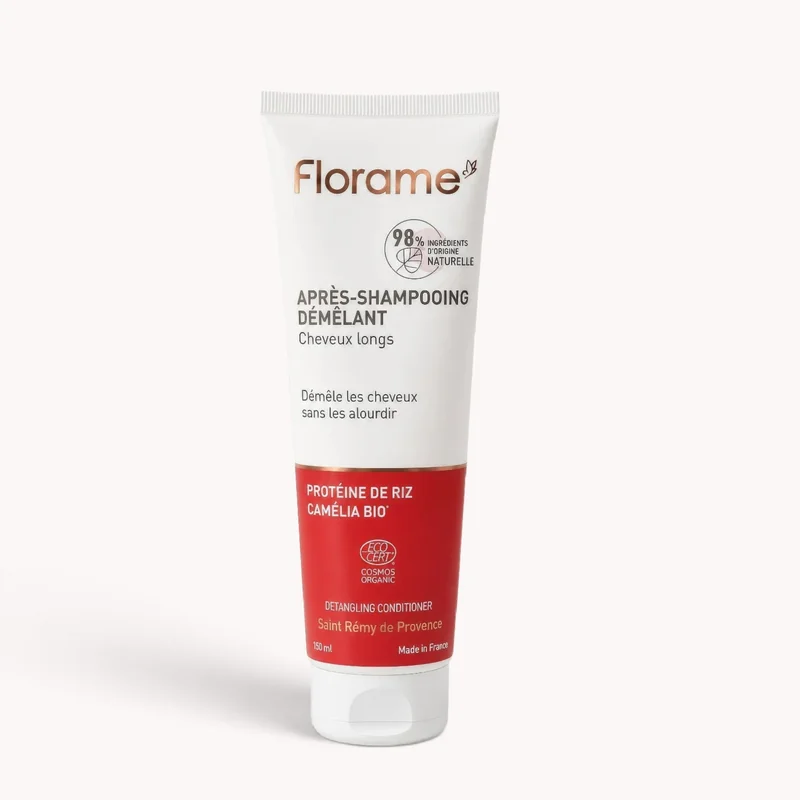
Photo: Florame — product image from the brand's own listing.
Our take
COSMOS Organic and stated vegan by Florame. It relies on two quaternary conditioning agents, which COSMOS allows, so organic here doesn't mean free of synthetic conditioners.
Evidence score
3/4
Well evidencedHow much of this product's ethics we can actually prove — not how ethical it is. Each point is a yes-or-no check you can verify.
- This product is certifiedIt holds at least one certification issued by an independent body — not by its maker.
- Covers more than one dimensionNot metIts certifications span at least two of nature, people and animals — not strong on one axis while silent on the rest.
- Composition publishedWe hold the full ingredient or materials list, per component where it matters, read from the maker's own listing.
- Composition mostly checkedAt least half of what it's made of has been matched against our sourced reference table.
Evidence at a glance
Three dimensions, weighted equally
1 of 3 independently certified
Certified means a third-party label backs it, with a source you can check. Stated means someone says so without one. Not found means we found nothing — not that the product fails.
- NatureCertifiedCOSMOS Organic
- PeopleNot foundNothing on record
- AnimalsStated onlyvegan — no certification found
What's inside
23 ingredients listed · 61% checked against our reference
The list as printed on the pack, in order — INCI runs from most to least concentrated, down to 1%. Flags cite EU law, not our opinion.
Aqua (Water)Solvent
Water. Usually the largest single component of a cream or lotion, which is why it heads most INCI lists.
Water at source ↗Cetearyl AlcoholEmulsifier and emollient
A fatty alcohol derived from plant oils, not a drying solvent alcohol despite the name. It thickens creams and holds oil and water together.
Cetearyl alcohol at source ↗Glycerinfrom organicHumectant
Draws water into the skin's surface layers. May be plant- or animal-derived; certified organic and vegan products use the plant route.
Glycerin at source ↗- Distearoylethyl Dimonium ChlorideNot assessed
Parfum (Fragrance)Perfuming
An umbrella term: the individual components need not be listed, except for the 80 allergens that must be named separately. A short INCI list with PARFUM on it is less transparent than it appears.
Fragrance at source ↗- Sesamum Indicum (Sesame) Seed OilorganicNot assessed
- Camellia Oleifera Seed OilorganicNot assessed
- Hydrolyzed Rice ProteinNot assessed
Aloe Barbadensis Leaf Juice PowderorganicSkin conditioning
Juice pressed from aloe leaves. Frequently listed high for marketing effect while present at low concentration — its position in the list matters more than its presence.
Aloe vera leaf juice at source ↗- Guar Hydroxypropyltrimonium ChlorideNot assessed
Helianthus Annuus (Sunflower) Seed OilEmollient
A light, widely available plant oil that is often grown in Europe, making it a lower-transport alternative to tropical oils.
Sunflower seed oil at source ↗- Lactic AcidNot assessed
- Cetearyl GlucosideNot assessed
Sodium HydroxidepH adjuster
Caustic soda, listed in Annex III with concentration limits. Used to neutralise a formula to skin-compatible pH; it is consumed in that reaction rather than remaining as such.
Sodium hydroxide at source ↗Citric AcidpH adjuster
Adjusts a formula towards the skin's slightly acidic pH. Present in small amounts near the end of most INCI lists.
Citric acid at source ↗Sodium BenzoatePreservative
Permitted preservative under Annex V within stated concentration limits. Accepted in organic-certified formulations.
Sodium benzoate at source ↗Potassium SorbatePreservative
Permitted preservative under Annex V within stated concentration limits. Accepted in organic-certified formulations.
Potassium sorbate at source ↗TocopherolAntioxidant
Protects oils in the formula from going rancid. Commonly added to plant-oil-heavy products for shelf life.
Vitamin E at source ↗CitronellolFragrance component
Declarable fragrance allergen: must be named on the label above 0.001% in leave-on or 0.01% in rinse-off products. Commonly occurs naturally in essential oils. Found in rose and geranium oils.
Citronellol at source ↗Benzyl SalicylateFragrance component
Declarable fragrance allergen: must be named on the label above 0.001% in leave-on or 0.01% in rinse-off products. Commonly occurs naturally in essential oils. Used as a fragrance and UV absorber.
Benzyl salicylate at source ↗LinaloolFragrance component
Declarable fragrance allergen: must be named on the label above 0.001% in leave-on or 0.01% in rinse-off products. Commonly occurs naturally in essential oils. Found in lavender, rosewood and coriander oils.
Linalool at source ↗- Beta-SitosterolNot assessed
- SqualeneNot assessed
Open any assessed entry to read what it does and why, with the source it came from. “Not assessed” means it isn't in our reference table yet — not that it's been cleared. We only mark what we can source. This list was read from Florame ↗, not reconstructed.
Other claims
Stated by the maker rather than certified by a third party — each one linked to where it's stated, so you can weigh it yourself.
Certification statement
COSMOS ORGANIC certifié par Ecocert Greenlife selon le référentiel COSMOS
Where this is stated ↗
Why it qualifies
The verifiable part — every certification this product holds, and what each one actually guarantees.
COSMOS Organic
COSMOS-standard AISBLOrganic-certified ingredients and environmentally sound processing, audited across the supply chain.
About Florame
French organic cosmetics and aromatherapy house, from essential oils and floral waters to skincare and perfume.
florame.com ↗Outbound links may be affiliate links. We never hold stock or process payments. Price bands are indicative and not tracked live — check the merchant for the current figure.